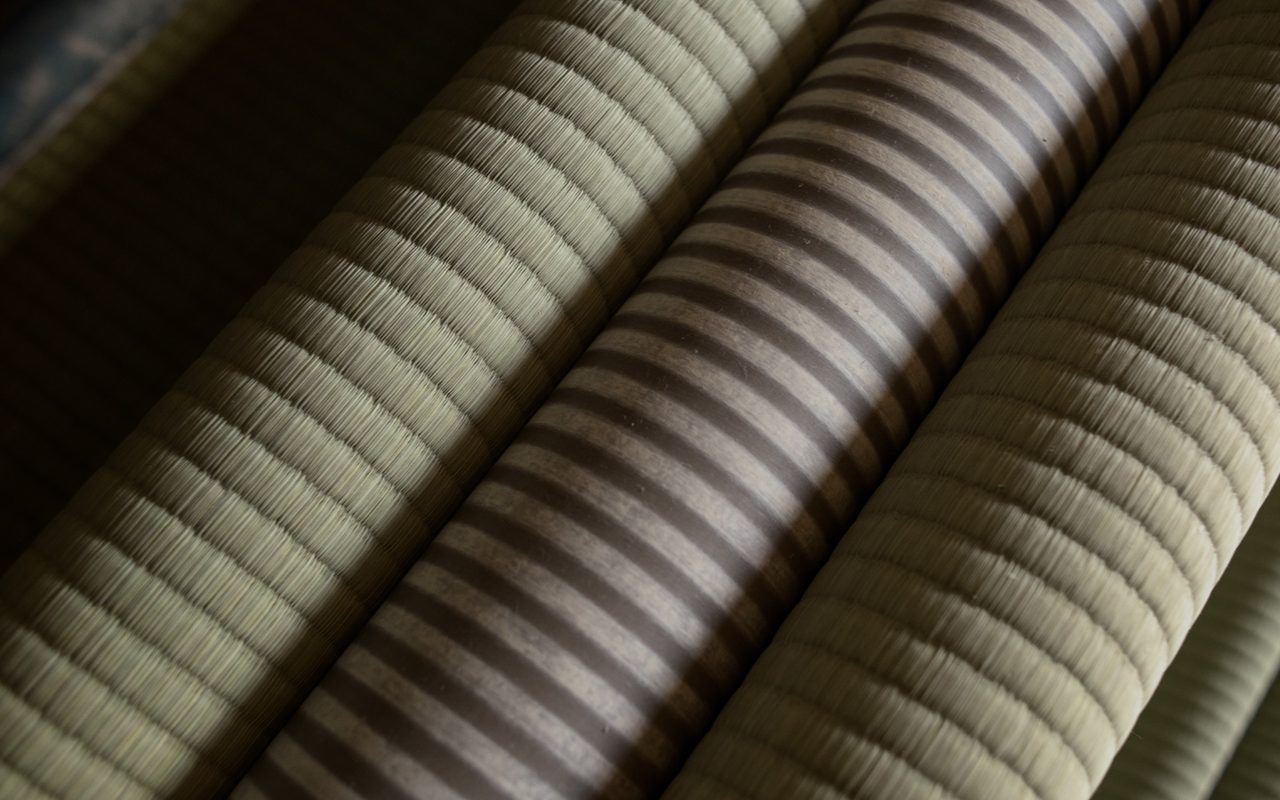
EP.151 · Igusa, Tatami · Kumamoto
Tatami: The Igusa Grass Mat that Breathes
Discover how Japanese tatami is made, from Kumamoto-grown igusa and traditional weaving to hand-finishing, aging, maintenance, and authentic Japanese provenance.
How Tatami Is Made, and How to Tell If Yours Is Japanese
Only about 18 percent of the tatami sold in Japan is made in Japan. In the most recent government figures, the country supplied roughly 5.6 million mat surfaces in a year and produced about 1 million of them domestically. The rest came in from overseas, almost entirely from China.
That is why the domestic ones now carry a QR code, woven inside the mat.
The tag in the weave
It is a small paper tag, tucked between the rushes during weaving and left there. Pull it out, scan the printed code, and it resolves to the registered details of the person who grew the rush and wove the mat surface. In Kumamoto, that is usually the same person.
The tag exists because once a mat surface is stretched over a core and edged, origin becomes invisible. The material passes through a regional wholesaler, then a materials wholesaler, then a tatami shop, before it reaches a floor. Nothing about the finished object announces where the plant was grown. The tag survives that chain, and government support for the sector now ties funding to raising the share of shipments that carry production-history tags.
Two things to know before you rely on it. The tag does not appear on every sheet. Depending on the producer it may be one in five, or every one, and it concentrates on upper grades. And a different tag is used when a Kumamoto farm grew the rush but a specialist weaver, rather than the farm, wove it. So absence of a tag is not proof of an import. Presence of one is good evidence of domestic origin.
The plant
Tatami is a grass floor. The surface is woven from igusa, a soft rush grown in flooded paddies, and everything that makes a tatami room feel the way it does comes from the properties of that plant.
Effectively all of Japan's domestic igusa now comes from Kumamoto Prefecture. Fukuoka, the only other producing prefecture, dropped to zero in 2022. The crop is registered under Japan's Geographical Indication system as Kumamoto-grown igusa, GI number 8, registered in February 2016, with a defined production area, approved varieties, and specified cultivation methods.
The scale is small. Government figures put the number of igusa-growing households at 223 in the most recent crop year, down 16 percent in a single year. There were 1,030 in 2006. At the industry's peak there were around ten thousand. Planted area is now 242 hectares.
A year in the paddy
The unusual thing about igusa is that the farm does not hand the crop to a workshop. The household that grows the rush is normally the household that weaves the mat surface, on a loom in a shed on the same property. Growing and weaving are one operation, spread across a single year.
Seedlings, August to November. Igusa is transplanted twice before it ever reaches the production paddy. First-year seedlings raised in a nursery bed are moved to a paddy nursery in August, grown on, then lifted again in mid November and divided by hand into small clumps. The dividing is the punishing part, because the root mass comes out tangled and has to be separated a few stalks at a time.
Planting, late November into December. The divided clumps go into the flooded production paddy in the coldest part of the year.
Top-shaving, May. The tops of the entire field are cut off. This sounds destructive and is the opposite. Removing the canopy lets light reach the base of the plants and triggers new shoots, and it is the shoots that emerge roughly 45 days before harvest that grow longest and finest. Length is the single biggest quality variable in the whole process. Grades are defined by it: 97 centimeters and up for the lowest, 140 centimeters and up for the highest.
Netting, May. The rush passes 150 centimeters, tall enough to fall over in wind, so netting is stretched across the whole paddy and the plants grow up through it.
Harvest, late June to mid July. Cutting happens at dawn or in the evening, when the air is cool. Rush cut in the middle of the day heats up in the bundle and discolors, and the color cannot be recovered afterward.
The mud
The same day it is cut, before it is allowed to dry, the rush is dipped in sendo, a very fine natural clay dissolved in water.
This is the step that produces almost everything people associate with tatami as a sensory object. The clay coats every stalk. That coating slows evaporation so the rush dries evenly rather than case-hardening on the outside, and it shields the chlorophyll and the internal structure from damage during drying. The result is even color, a slight sheen, and a surface that holds its appearance for years instead of months.
It is also where the smell comes from. What most people register as the scent of a tatami room is the hay note of the rush blended with the clay it was dipped in. Take the mud dyeing away and you lose the smell.
The technique dates to the middle of the Edo period and is written into the GI registration as a defining characteristic of the crop.
After dyeing, the rush is machine dried, then sorted by length, checked for damage and evenness of thickness, and stored.
Weaving the goza
The woven surface has its own name. It is a goza, a rush mat woven with the igusa running across as weft and threads running lengthwise as warp. This is what the farm produces and sells. It is not yet a tatami.
A single mat surface takes roughly 4,000 to 7,000 stalks. That range is not a rounding error, it is the grade. Standard material runs around 4,000 to 5,000. Top material runs 6,000 to 7,000, packed dense enough that the weave has real thickness and weight, and that density is what makes it last.
The warp threads control how much rush can be packed in. Cotton warp is the standard. Hemp is stronger and permits a denser beat-up. The highest grades use two warp threads per weave interval, which pulls each ridge of the weave into a crisp line rather than a soft one. Kumamoto material also carries a prefectural certification thread in the warp, in a designated color, as a second origin marker alongside the tag.
Only the middle of each stalk is used. The root end and the tip are cut away, because they are uneven in color and thickness, which is why long rush produces better material. More usable middle per stalk.
Finished goza are inspected by hand, one at a time, against the prefecture's standard before they can be shipped and stamped.
From goza to tatami
Here the craft changes hands entirely. The farm's work ends with a roll of goza. Turning it into a floor is a different trade, practiced by tatami makers all over the country, with its own national trade certification.
The first thing to understand is that there is no such thing as a standard tatami. Mats are sized to the room they go into. Walls bow, thresholds warp, pillars intrude into the corner, and every mat in a six-mat room can be a slightly different size. So the process starts with someone on their knees in the actual room with a measure.
Nominal sizes still vary by region, which is a leftover of tatami having once been the unit of measurement for architecture itself. Kyoto and western Japan use the largest format at roughly 191 by 95.5 centimeters. Central Japan uses about 182 by 91. The Tokyo format is about 176 by 88. Apartment blocks use a smaller one again at about 170 by 85. A six-mat room is not one size.
The core. Under the goza sits the tatami-doko. Traditionally this is rice straw, layered and compressed under enormous pressure into a slab. Most modern cores are a sandwich of insulation board and polystyrene foam, which is lighter, more stable, and considerably cheaper. Straw cores breathe better and are heavier to work with. For a refacing job, the existing core is repaired first, with gaps filled and the surface leveled, because any low spot in the core will read straight through the finished mat.
Stretching and the end seam. The goza is laid over the core and pulled taut, then sewn down at the short ends. That seam is the kamachi-nui, named for the kamachi, the short end edge of the mat. On a hand-sewn mat the maker tensions only the goza while sewing this seam, where a machine pulls the goza and the core together. The hand method produces a visibly tighter surface, and it is the main reason hand-sewn mats still exist.
The border. The tatami-beri, the fabric edging, is sewn along the two long sides in an operation called hirazashi. It is structural before it is decorative. It protects the vulnerable long edge where the weave would otherwise fray, and it was historically a rank marker, with pattern and color regulated by status.
The corners. After the border is on, each corner is worked square by hand. This is the step that separates a good mat from an acceptable one, and it is almost entirely feel.
The return seam. Finally the border is folded down the side of the core and stitched to it, the kaeshi-nui, and the mat is inspected and wiped down.
Traditional hand sewing covers four operations: the end seam, the border seam, the return seam, and the corners. In practice even shops that describe themselves as hand-sewing now usually machine the long border seam, because it is the most repetitive and least expressive of the four.
One refinement worth knowing: on straw-core mats, some makers sew a thin board into the short edge before the goza goes on. Straw cores compress over time, which rounds off the sharp corner and shortens the mat. The board holds the edge square for decades. It is slow, it requires a maker trained on straw, and it costs accordingly.
Fitting. The finished mats are carried into the room and set in place. Because each one was cut to its own position, they only fit one way, and a room of tatami sits with no gaps at the walls and none between mats.
How it ages and how it is kept
Good igusa does not stay green. It moves through to a deep amber over years while keeping its sheen, and high-grade material can pass a decade without the surface layer breaking down. Lower-grade material darkens unevenly and starts shedding much sooner. The difference is invisible on delivery and obvious at year five, which is the wrong timeline for a specification decision.
Maintenance runs on two cycles. At roughly two to three years, the goza is unpicked and flipped, putting the unworn face up. At three to five years it is replaced entirely and the core is reused. Both intervals move considerably with traffic and material quality.
The material also keeps working after it is laid. Each stalk holds a honeycomb of air pockets, which is why a traditional six-mat room with a straw core is reckoned to hold around three liters of moisture from the air and give it back as the room dries. The same structure absorbs airborne compounds including formaldehyde, and softens impact sound rather than reflecting it.
Why the numbers keep falling
Domestic mat surfaces run at roughly 2.3 times the price of Chinese material, averaging about 2,176 yen per sheet in the most recent crop year. That gap is the entire reason the domestic share collapsed from 70 percent of supply in 1996 to around a fifth by 2007, where it has stayed.
The response has been to move upmarket rather than compete on price. Kumamoto has pushed improved varieties bred for length, fineness, and even color, and adoption of the four approved varieties has reached 97 percent of planted area. The QR tagging, the certification threads, and the GI registration all serve the same strategy: make provenance legible so the price gap reads as a quality gap. In March 2025 the prefecture went further and enacted an ordinance specifically for the promotion of igusa and tatami.
(written with the help of AI)